


Page path:
ECORD Summer School 2012
"Submarine Landslides, Earthquakes and Tsunamis"
3 - 14 September 2012
at the MARUM - Center for Marine Environmental Sciences and
the IODP Bremen Core Repository, University of Bremen, Germany
the IODP Bremen Core Repository, University of Bremen, Germany

1 The Aim
The major goal was to bring PhD students and young Postdocs in touch with IODP at an early stage of their career, inform them about the actual research within this international scientific program, and to prepare them for future participations in IODP expeditions. Such training will be achieved by taking the summer school participants on a “virtual ship” where they get familiarized with a wide spectrum of state-of-the-art analytical technologies and core description methods according to the high standards on IODP expeditions. Therefore the course was equally balanced, with half the time dedicated to lectures and discussions and the other half to laboratory exercises.
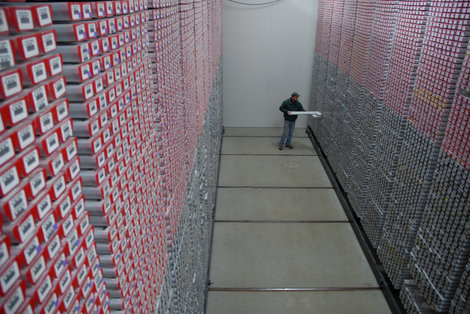
Located on the university campus, MARUM hosts the IODP Bremen Core Repository (BCR), the only IODP core repository in Europe.
2 Location and Organisation
The ECORD Summer School on “Submarine Landslides, Earthquakes and Tsunamis” 2012 was held September 3-14, 2012 at the MARUM – Center for Marine Environmental Sciences, Bremen University, Germany. It has been organized by Prof. Dr. Dierk Hebbeln, Director of the Bremen International Graduate School for Marine Sciences „Global Change in the Marine Realm“ (GLOMAR), by Prof. Dr. Katrin Huhn, head of the group on Modelling Sedimentation Processes at the University of Bremen, by Prof. Dr. Michael Strasser, Assistant Professor for Sediment Dynamics at the ETH Zurich, and by Dr. Ursula Röhl, head of the IODP Bremen Core Repository (BCR). GLOMAR, MARUM and BCR jointly offered the unique training possibilities used for this summer school by providing laboratory facilities and by providing a seminar room equipped with 20 laptops (internet access, MatLab etc.). Additional funding to carry out the Summer School has been provided by the IGCP Working Group 585.
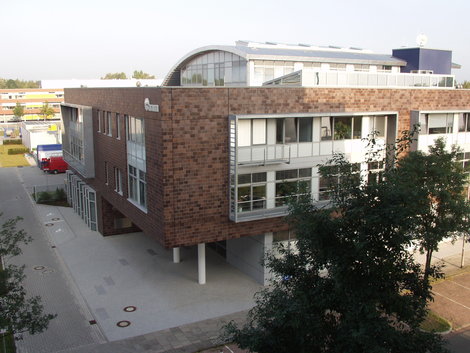
MARUM - Center for Marine Environmental Sciences
3 The Topic
Earthquakes have devastating effects on heavily populated coastal areas from both, ground shaking and tsunami. Submarine landslides and catastrophic volcanic flank collapse (and associated tsunamis) pose additional significant risks to coastal populations and to seafloor infrastructures. Together, these processes comprise a significant large-scale natural hazard for which no short-term prediction methods exist. Improving our understanding of when, where, and how large-scale earthquakes and slope failures occur, is one of the most urgent and challenging tasks faced by modern Earth sciences. Scientific ocean drilling is uniquely positioned to elucidate the underlying geologic processes that govern the nature and evolution of submarine earthquakes, faulting, and seafloor displacement processes through direct sampling and in situ measurement, including continuous real-time monitoring.
4 Programme
The two-week course combined lectures and interactive discussions on Submarine landslides, earthquakes and tsunamis with practical exercises, with the latter mainly using the facilities of the BCR. The scientific lectures and exercises have been confined mostly to the morning sessions, whereas the “virtual ship” related practicals mainly took part during the afternoon sessions.
In the morning sessions the program (see attachment) focused on lectures and discussions which were given and guided by leading scientists from the field (see below). These sessions have been grouped in the following sub-themes:
• Earthquakes and Tsunamis,
• Submarine Landslides, and
• Plate Boundary Dynamics and Earthquakes
After lunch the participants got the opportunity to present their own research work and to discuss it with their fellow participants and with some of the summer school lectures, thereby enabling them to build on their own international networks. The afternoon sessions took advantage of the unique facilities of the Bremen IODP core repository and labs and aimed at introducing PhD students and young Postdocs to a full range of IODP related topics from general introduction to the program to compiling of IODP proposals and to get an insight into “shipboard” methodologies applied on the drilling vessels. The focus was on group-based practicals focusing on standard shipboard methodologies such as core description, physical properties, pore water extraction, and borehole logging as well as on more thematically focused approaches with respect to slope failure and sediment physical characterization.
The weekend between the first and the second week was partly used a field trip to visit coastal protection infrastructures and discuss the preparedness to potential offshore geohazards in the low-lying coastal areas along the North Sea coast line and gave the participants the possibility to explore the city of Bremen at the free Sunday.
In the morning sessions the program (see attachment) focused on lectures and discussions which were given and guided by leading scientists from the field (see below). These sessions have been grouped in the following sub-themes:
• Earthquakes and Tsunamis,
• Submarine Landslides, and
• Plate Boundary Dynamics and Earthquakes
After lunch the participants got the opportunity to present their own research work and to discuss it with their fellow participants and with some of the summer school lectures, thereby enabling them to build on their own international networks. The afternoon sessions took advantage of the unique facilities of the Bremen IODP core repository and labs and aimed at introducing PhD students and young Postdocs to a full range of IODP related topics from general introduction to the program to compiling of IODP proposals and to get an insight into “shipboard” methodologies applied on the drilling vessels. The focus was on group-based practicals focusing on standard shipboard methodologies such as core description, physical properties, pore water extraction, and borehole logging as well as on more thematically focused approaches with respect to slope failure and sediment physical characterization.
The weekend between the first and the second week was partly used a field trip to visit coastal protection infrastructures and discuss the preparedness to potential offshore geohazards in the low-lying coastal areas along the North Sea coast line and gave the participants the possibility to explore the city of Bremen at the free Sunday.
Lecturers
| Name | Institute |
| Jan Behrmann | IFM Geomar, Kiel |
| Marco Bohnhoff | GFZ Potsdam |
| Angelo Camerlenghi | ICREA University of Barcelona |
| Thorsten Dahm | GFZ Potsdam |
| Jochen Erbacher | BGR, Hannover |
| Walter Hale | MARUM, Bremen |
| Dierk Hebbeln | MARUM, Bremen |
| Kartin Huhn | MARUM, Bremen |
| Andre Hüpers | MARUM, Bremen |
| Matt Ikari | MARUM, Bremen |
| Jenny Inwood | Borehole Research Group (EPC), Leicester |
| Martin Kölling | MARUM, Bremen |
| Holger Kuhlmann | MARUM, Bremen |
| Nina Kukowski | University of Jena |
| Lisa McNeil | National Oceanography Centre (NOCS), Southampton |
| Ursula Röhl | MARUM, Bremen |
| Luzie Schnieders | MARUM, Bremen |
| Michael Strasser | Swiss Federal Institute of Technology (ETH), Zurich |
| Rüdiger Stein | AWI, Bremerhaven |
| Stefano Tinti | University of Bologna |
| Harold Tobin | University of Wisconsin-Madison |
| Roger Urgeles | Spanish National Research Council (CSIC) |


5 Participants
A total of 31 PhD students and young post-docs from several countries -
Australia, Belgium, Canada, France, Germany, Ireland, Israel, Italy, Norway, Portugal, Spain, Switzerland, United Kingdom -
participated in the ECORD Summer School 2012.
Within the summer school, the participants were given the opportunity to present their own projects in 15-minutes talks.
Mr Gauvain Wiemer (University of Bremen) received the award for the best oral presentation.
Australia, Belgium, Canada, France, Germany, Ireland, Israel, Italy, Norway, Portugal, Spain, Switzerland, United Kingdom -
participated in the ECORD Summer School 2012.
Within the summer school, the participants were given the opportunity to present their own projects in 15-minutes talks.
Mr Gauvain Wiemer (University of Bremen) received the award for the best oral presentation.

6 Feedbacks
Questionnaires collected at the end of the summer school recorded the overwhelming positive feedbacks from the participants. Some hints (more short breaks, more detailed personal introduction of participants, etc.) will be considered in the preparation of the Bremen ECORD Summer School 2013.
Report by a Group of Summer School Participants
ECORD Newsletter # 19, Pages 8 and 9
Sponsors
