




- Wir über uns
- Alumni
- Ehemalige Mitarbeiterinnen und Mitarbeiter
- Krupiński, Szymon
Dr. Szymon Krupiński
Archivierte Seite
Diese Webseite wird seit dem Ausscheiden der Kollegin / des Kollegen aus dem MARUM nicht mehr aktualisiert. |
Wissenschaftliche Interessen und Fachkenntnisse
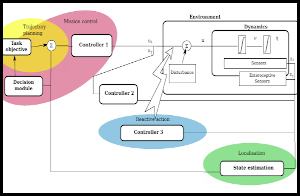
Embedded Intelligence and Control for Autonomous Marine Vehicles
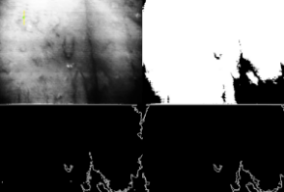
Sonar, Video and Laser scanner data processing
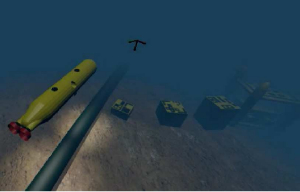
Autonomous Underwater Vehicle simulation
Bio
Dr. Szymon Krupiński was awarded a BSc degree in Electrical Engineering and Computer Science at International University Bremen (currently Jacobs University Bremen) in 2005 and presented a diploma work entitled “Development of a small autonomous underwater vehicle”, carried out under the supervision of Prof. Dr. A. Birk. He has completed his MSc degree at the Ship Science Department of Southampton University in 2007. His thesis was entitled “Image recognition in performance and manoeuvring analysis of a racing dinghy” and was supervised by Prof. S.R. Turnock. In 2014 he submitted and successfully defended his PhD thesis entitles "Offshore structure following by means of sensor servoing and sensor fusion" (domain: Automation, Signal and Image Treatment) at Laboratoire I3S, Université Nice Sophia Antipolis, France, under the supervision of Prof. Tarek Hamel and Dr. Guillaume Allibert.
2017 - 2020
Postdoktorand und Dozent für Informatik an der Jacobs University Bremen, Deutschland
- Automation
- Computer Graphics
- Marine Robotics
- Data Visualisation and Image Processing
- Programming in C/C++
2007 - 2017
Research and Software Engineer bei Cybernetix, Oil and Gas (2007-2010), Innovation (2010-2015), Software and Algorithms (2015-2017), Marseille, Frankreich
2006 - 2007
Modelling Engineer bei Det Norske Veritas (derzeit DNV-GL), Nauticus Research Centre, Sopot, Polen
Publikationen
- L. Mucolli, S. Krupinski, F. Maurelli, S. A. Mehdi and S. Mazhar, Detecting cracks in underwater concrete structures: an unsupervised learning approach based on local feature clustering, IEEE OCEANS 2019 MTS/IEEE SEATTLE, October 2019
- (submitted for review) F. Maurelli, S. Krupinski and X. Xiang, AUV localisation: a review of passive and active techniques, Int. Journal of Intelligent Robotics and Applications, January 2019
- G. Allibert, M-D. Hua, S. Krupinski and T. Hamel, Pipeline following by visual servoing for Autonomous Underwater Vehicles, Control Engineering Practice, January 2019
- S. Krupinski, F. Maurelli, Positioning aiding using LIDAR in GPS signal loss scenarios, 8th IEEE International Conference on Underwater System Technology, Dec. 2018, link
- F. Maurelli, S. Krupinski, A semantic-aided particle filter approach for AUV localisation, IEEE OCEANS 2018 Kobe (pp. 1-9), May 2018
- S. Krupinski, G. Allibert, M-D. Hua and T. Hamel, An inertial-aided homography-based visual servoing control approach for (almost) fully-actuated Autonomous Underwater Vehicles, IEEE Trans. on Robotics, Dec. 2016
- S. Krupinski, R. Desouche, N. Palomeras, G. Allibert and M-D. Hua, Pool testing of AUV visual servoing for autonomous inspection, IFAC Workshop on Navigation, Guidance and Control of Underwater Vehicles, April 2015
- S. Krupinski, G. Allibert, M-D. Hua and T. Hamel, Pipeline tracking for fully-actuated autonomous underwater vehicle using visual servo control, American Control Conference, June 2012
- F. Maurelli, Y. Petillot, A. Mallios, P. Ridao and S. Krupinski, Sonar-based AUV localization using an improved particle filter approach, IEEE OCEANS 2009-Europe, May 2009
- S. Krupinski, F. Maurelli, A. Mallios, P. Sotiropoulos and T. Palmer, Towards AUV docking on sub-sea structures, IEEE OCEANS, May 2009
- F. Maurelli, S. Krupinski, Y. Petillot, and J. Salvi, A particle filter approach for AUV localization, IEEE OCEANS 2008, September 2008
- S. Krupinski, F. Maurelli, G. Grenon and Y. Petillot, Investigation of autonomous docking strategies for robotic operation on intervention panels, IEEE OCEANS, Sept. 2008